The Unitree 2026 lineup covers quadrupeds and humanoids built for very different needs: from research to industrial inspection, from education to company POCs. This guide is a real model map: for each one you will find technical features, what it is for and in which sectors it makes sense.
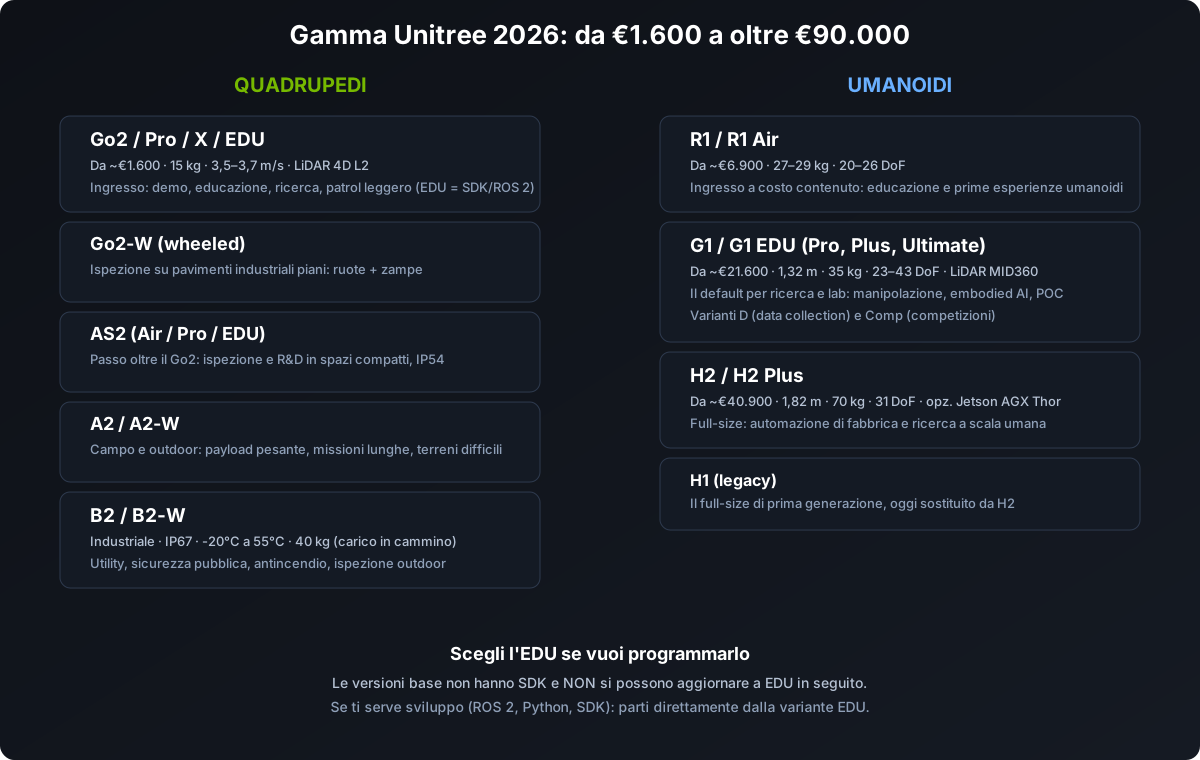
The golden rule before choosing
The first question is not "which model" but "do you need to program it?". Base versions have no SDK and there is no upgrade to EDU after purchase: if you think you will ever write code (ROS 2, Python, SDK), start with the EDU variant. EDU models also add NVIDIA Jetson Orin compute (40-100 TOPS) for onboard perception, navigation and learned policies.
Quadrupeds
Go2 / Go2 Pro / Go2 X / Go2 EDU
The entry point into legged robotics. ~15 kg, 12 motors, 4D LiDAR L2 and RL-trained gaits. The differences between versions are computing, autonomy and SDK:
| Variant | Indicative price | Speed | SDK | Typical use |
|---|---|---|---|---|
| Air | ~€1,600 | 2.5 m/s | No | Demos, hobby |
| Pro | ~€3,800 | 3.5 m/s | No | Content, classroom |
| X | ~€7,600 | 3.7 m/s | No | Prosumer |
| EDU | ~€11,200+ | 3.7 m/s | Yes | Research, university, development |
| Ent | ~€13,200+ | 3.7 m/s | Yes | Commercial patrol, sensing |
Sectors: education, research (locomotion, navigation), demos and events, light indoor patrol.
Go2-W (wheeled)
The Go2 with wheels on its feet: faster and more efficient on flat industrial floors, but it keeps the legs for steps and rough ground. Ideal for routine facility inspection rounds. With the "Inspection" package it becomes a turnkey solution for inspection rounds.
Sectors: indoor factory and warehouse inspection, facility management.
AS2 (Air / Pro / EDU)
The intermediate step between Go2 and B2: ~20 kg, roughly twice the power of the Go2, IP54 on Pro and EDU. It is the right choice when a Go2 is too "light" but an industrial platform is overkill. Capable of 65 kg of static load, designed for inspection and R&D in compact spaces.
Sectors: small/medium plant inspection, security patrol in tight areas, R&D labs.
A2 / A2-W
A field platform: IP56, -20°C to 55°C, over 5 hours of autonomy (hot-swap batteries), static load up to 100 kg, steps up to 30 cm, 3.7 m/s. Designed for long outdoor missions in demanding terrain.
Sectors: outdoor inspection, agriculture, environment, difficult terrain missions.
B2 / B2-W
The true industrial platform: IP67 (submersion up to 1 m), 40 kg payload while walking (120 kg static), 4-6 hours of autonomy, -20°C to 55°C. A Fire and Rescue configuration also exists. It is the direct competitor of the Boston Dynamics Spot at a fraction of the cost.
Sectors: utilities and energy plants, public safety, fire and rescue, mine and large plant inspection, hazardous environments.
Humanoids
R1 / R1 Air
The cheapest way to start with a humanoid: ~€6,900 for the Air (20 DoF), ~€9,000 for the base (26 DoF), up to ~€33,000 for the EDU Pro. ~1 hour of autonomy. EDU versions unlock the SDK for teaching.
Sectors: schools, vocational training, first lab experiences, research on tight budgets.
G1 / G1 EDU (Standard, Plus, Pro, Ultimate)
The "default" of humanoid research: 1.32 m, ~35 kg, 23-43 DoF, MID360 LiDAR, RealSense D435i, quick-release ~2-hour battery, foldable design. EDU adds Jetson Orin (100 TOPS), Dex3-1 hands, teleop and much more. Dedicated variants exist: G1-D (data collection for imitation learning), G1-Comp (athletic competitions). More than 16 configurations in the catalogue.
Sectors: research and universities, embodied AI, manipulation, company POCs, data collection for AI, events/demos.
H2 / H2 Plus
The full-size humanoid: 1.82 m, ~70 kg, 31 DoF, arm torque up to 120 N·m, ~3 hours of autonomy, Intel Core i5/i7 and optional Jetson AGX Thor (2,070 TOPS) for onboard inference of large models. It is the platform to work at human scale: reach, stride and interaction with human-designed environments.
Sectors: factory automation, logistics, human-scale research, high-profile "presence" projects.
Model → sector map (quick guide)
| Sector | Recommended models |
|---|---|
| Research / university | Go2 EDU, G1 EDU, H2 EDU |
| Education | R1, Go2 (Air/Pro) |
| Industrial inspection | Go2-W, AS2, A2, B2 |
| Security patrol | Go2 Ent, AS2, A2 |
| Public safety / fire | B2 / B2-W |
| Events and demos | Go2, G1 base, R1 |
| Data collection for AI | G1-D, R1-D |
| Factory automation | H2 / H2 Plus |
How to choose: a decision tree
- Outdoor, dust, rain, extreme temperatures? → B2 (or A2 for longer missions).
- Heavy sensors or an arm to mount? → A2 or B2; on flat indoor consider Go2-W.
- Light inspection or demos in controlled environments? → Go2 (EDU if you want to program).
- Humanoid research lab? → G1 EDU; human scale → H2; teaching budget → R1 EDU.
- Not sure if you will program: → buy EDU. You cannot upgrade later.
Which Unitree is right for you? Try it
Answer four questions and get a starting recommendation (always validate against a real use case).
1. Where will the robot work?
2. Humanoid or quadruped?
3. Do you need to program it (SDK, ROS 2)?
4. Indicative budget
G1 EDU: the configuration table
The most expensive mistake is choosing the wrong G1 variant. The base (G1 and G1 Pro) has no SDK and cannot be upgraded: for research, policy training or ROS 2 you need an EDU from day one. The comparison:
| Configuration | SDK | DoF | Indicative price |
|---|---|---|---|
| G1 (base) | No | 23 | ~$21,600 |
| G1 Pro | No | 23 | ~$27,990 |
| G1-D (data collection) | Yes | mobile platform | ~$38,800-66,300 |
| G1 Edu Standard | Yes | 23 | ~$43,900 |
| G1 Edu Pro | Yes | up to 37 | ~$45,900-56,900 |
| G1-Comp (athletic) | No | - | ~$48,900 |
| G1 Edu Plus | Yes | 29 · 100 TOPS | ~$53,900 |
| G1 Edu Combat | Yes | - | ~$63,900 |
| G1 Edu Ultimate | Yes | up to 43 | ~$55,900-73,900 |
Rule of thumb: if someone on the team will write code for the robot, the minimum viable purchase is Edu Standard. Choose sensors and hands in the original configuration: retrofitting is difficult and never cheap. The same rule applies to H2: the base has no SDK, for development you need H2 Edu.
H2 in the factory: the industrial case
The H2 is among the first commercial humanoids that integrate into existing lines without reworking workstations: 1.82 m tall, 7-DoF arms that use tools designed for humans, ~15 kg peak payload per arm and leg torque up to 360 N·m for stability under load. Field-verified uses: box picking and palletising, component placement, visual quality control, cold warehouse inspection and power plant patrol (tests with State Grid). By the end of 2026 cumulative H2 series orders exceed 2,300 units, with production of ~220 units/month.
In the factory, H2 and G1 combine: H2 for large tasks (load, pallet), G1 for precision, manipulation and tight spaces.
Developing: SDK2 and ROS 2
EDU platforms expose unitree_sdk2 (C++ and Python) with communication based on CycloneDDS: the same middleware as ROS 2, so you can drive the robots with ROS 2 messages directly, without wrappers. Typical network on humanoids: 192.168.123.x. Two control levels:
- High-level — motion commands (stand, walk, squat, zero torque), sport-mode states, request/response.
- Low-level — control of individual joints with target, gain, damping and feed-forward torque.
For research, the official URDFs (repo unitree_ros) let you simulate in MuJoCo or Isaac before deploying in debug mode. Read more: G1 programming and ROS 2 on Unitree.
Deployment reality: what nobody tells you
- Battery: real autonomy under dynamic load drops to 40-50% of the rated values. Plan frequent recharges.
- Wear: joint gearboxes wear out in high-cycle industrial environments: periodic maintenance is expected.
- Software: besides ROS 2 there is proprietary middleware; open-source compatibility varies by generation. Pin SDK and firmware versions.
- Fall recovery: works well on flat ground, degrades on uneven floors or debris.
FAQ
- Can I upgrade a Go2 base to EDU? No. SDK and compute are chosen at purchase.
- Which is the best seller? The Go2 family (over 170,000 cumulative Go1/Go2 units): it is the universal entry point.
- B2 vs Boston Dynamics Spot? B2 costs a fraction and has IP67, 40 kg payload and 4-6 hours of autonomy (vs ~90 min of Spot); Spot has a more mature enterprise software ecosystem.
- How long do batteries last? Go2: 1-2h (EDU with long battery 2-4h); G1: ~2h; H2: ~3h; B2: 4-6h.
Deep dives
Deep dives: Go2 vs Go2 Pro, G1 operational guide, quadruped for industrial inspection, humanoid comparison, complete Unitree in Italy guide.
Sources and useful links
This map synthesises official documentation, market guides and third-party reports (updated to 2026). Dig deeper directly from the sources:
- Unitree Robotics — official site and specs
- Unitree — technical documentation (SDK, ROS 2, Go2/G1/H2)
- Global Drone HQ — Unitree Buyer's Guide 2026 (all models)
- Global Drone HQ — G1 configuration guide (base/Pro/Edu)
- GitHub — unitree_sdk2 (official C++/Python SDK)
- GitHub — unitree_ros (URDF and simulation models)
- Robotlar — Unitree H2 for factory automation
- RobotWale — deployment reality, limits and constraints