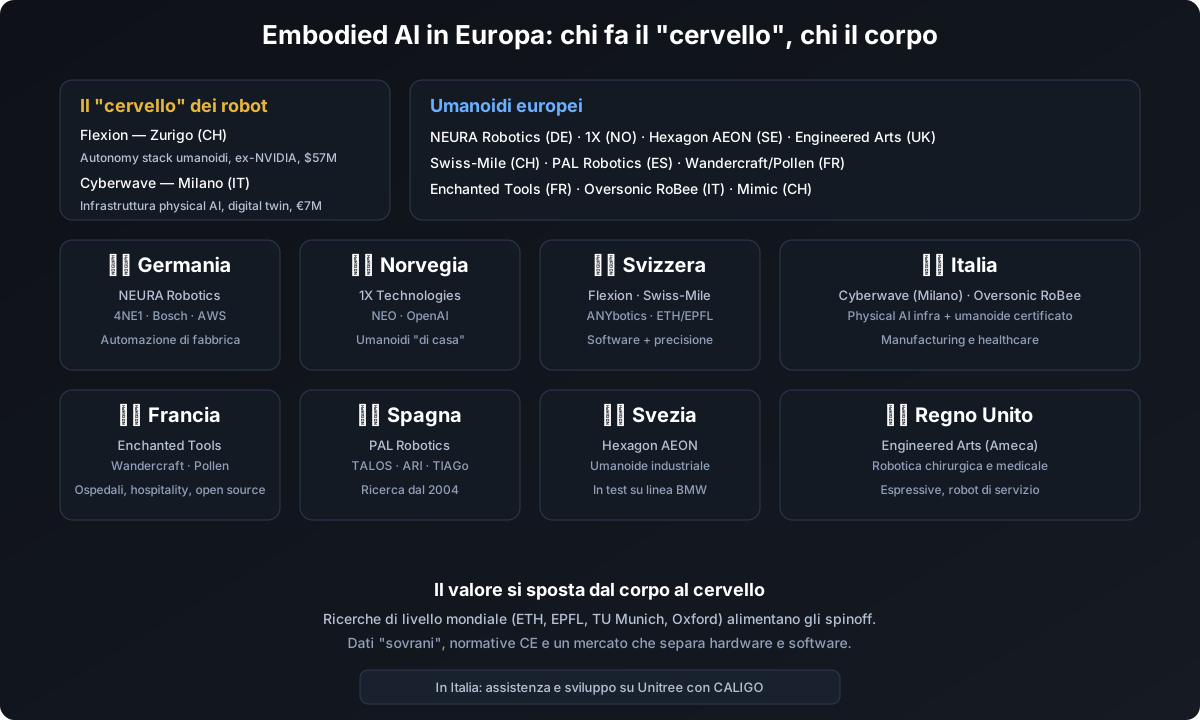
When we talk about modern robotics, the centre of gravity has shifted from hardware to intelligence: companies that do not build the robot body but the brain, the digital twins and the infrastructure to make robots work. In Europe this embodied AI and physical AI ecosystem is growing fast, supported by world-class research. This guide maps who does what in Europe in 2026 and how to get oriented.
What "embodied AI" means
Embodied AI (or physical AI) is AI that acts in the physical world through a body: it does not just reason over text or images, it perceives, plans and moves. The difference from traditional robotics is huge:
| Traditional robotics | Embodied AI | |
|---|---|---|
| Programming | Explicit rules and scripts | Learned policies (RL, imitation) |
| Generalisation | Task-specific | Adaptive to new scenarios |
| Data | CAD and manual logic | Simulation + teleop + telemetry data |
| Critical gap | Mechanics and integration | The "brain" and the data |
For this reason the value chain is splitting into three layers: who makes the body (hardware), who makes the brain (software/autonomy), who makes the infrastructure (digital twins, orchestration, cloud).
The "brain" of robots: the software players
Flexion — Zurich (Switzerland)
Founded in early 2025 by ex-NVIDIA researchers — Nikita Rudin and David Hoeller, the creators of Isaac Lab — Flexion is the startup that "builds the brain of humanoids". It has raised $57M (seed $7.35M + Series A $50M from DST Global, NVentures, redalpine, Prosus, Moonfire). Its autonomous stack has three layers:
- Command layer — language models that translate a natural-language command into subtasks.
- Motion layer — a vision-language-action model trained mainly on synthetic simulation data.
- Control layer — transformer-based whole-body control with a modular skill library.
The result (the Reflect v1.0 platform) executes long-horizon tasks: picking up a parcel, using stairs and elevators, opening doors, unpacking a box and putting items away — from a single command, without an operator.
Cyberwave — Milan (Italy)
Cyberwave calls itself "SAP for the physical world": a code-first infrastructure to program, simulate and orchestrate heterogeneous robots (arms, AGVs, humanoids, drones) through universal APIs and digital twins. Founded in Milan in 2025 by Simone Di Somma and Vittorio Banfi, it has raised €7M (United Ventures, The TechShop) and operates between Italy, Switzerland and the USA. It also researches Robot Foundation Models (VLA) and mixed-fleet orchestration with a safety envelope in code. It already has a Unitree G1 EDU in its lab.
European humanoid hardware
NEURA Robotics — Germany (Metzingen)
The best-funded humanoid company in Europe: over €1 billion raised (strategic partnerships with Bosch and Amazon Web Services). Its cognitive humanoid 4NE1 is in production ("Europe's first production-ready humanoid"), with a €17M training facility near Munich. A "one-device" approach that goes from industry to home, with the Neuraverse ecosystem.
1X Technologies — Norway (Moss) / USA
Backed by OpenAI (~$137M raised). It makes NEO, the first consumer "home" humanoid: ~30 kg, 22-DoF hands, pre-orders at ~$20,000 or $499/month, first deliveries in 2026. The EVE platform targets industry and logistics. Signature technique: RL policies trained from human motion-capture data.
Swiss-Mile — Switzerland (Zurich)
ETH spin-off: wheel+leg robots for last-mile delivery and urban logistics. Seed of $22M co-led by Jeff Bezos (Bezos Expeditions) and HongShan. It combines wheel efficiency with legged ability to overcome obstacles.
Other players by country
| Country | Company | Focus |
|---|---|---|
| Spain | PAL Robotics | TALOS, ARI, TIAGo — humanoid research since 2004 |
| France | Enchanted Tools | Mirokaï — hospitals and hospitality, "friendly" design |
| France | Wandercraft / Pollen | Exoskeletons→humanoids; Reachy (acquired by Hugging Face) |
| Italy | Oversonic | RoBee — humanoid certified for industry+healthcare, already at STMicroelectronics |
| Sweden | Hexagon (AEON) | Industrial humanoid tested on BMW's line (Leipzig) |
| UK | Engineered Arts | Ameca — expressive robots for showcases and research |
| Switzerland | ANYbotics | ANYmal quadruped for industrial inspection |
| Switzerland | Mimic Robotics | Humanoid hands that learn by watching (ETH spin-out) |
Why Europe really matters
- Frontier research: ETH Zurich, EPFL, TU Munich and Oxford feed the spin-offs — most European software players come from these centres.
- Sovereign data and models: foundation models trained on European industrial data, with European safety standards, are a different product from US/China ones.
- Regulations and safety: CE marking and machinery directives are a competence European integrators have mastered for decades.
- Body/brain split: Europe has precision hardware (Switzerland), automation (Germany), surgical robotics (UK) and now autonomy software (Zurich, Milan).
How to choose a partner for a project in Italy
For an Italian company or lab, the question is less "which European company is most famous" and more what kind of competence you need:
- Define the level: do you need hardware (a robot), software (policy/autonomy) or end-to-end integration (POC to deployment)?
- Ask who follows support and development after delivery: hardware without local support is a hidden cost.
- Check references in your domain: inspection, manipulation, R&D, teaching.
- Define KPIs and a go/no-go plan before investing: uptime, task success rate, costs.
- Consider incentives: many projects qualify for grants and Transition 5.0 — see the guide on robotics financing.
Interactive map of European embodied AI
Select a country to see who operates in that ecosystem.
Select a country
Click the map to see which companies operate in that country.
The research → startup pipeline
The engine of European embodied AI is the academia → company pipeline: Flexion comes from ETH Zurich and NVIDIA, Swiss-Mile from ETH, Mimic from ETH, Embodied AI from EPFL. The centres that matter: ETH Zurich and EPFL (Switzerland), TU Munich (Germany), Oxford (UK), IIT Genoa (Italy). For anyone entering the sector, the spin-offs of these centres are the main channels for talent, technology and partnerships — and often the fastest way to validate a technology before investing in hardware.
Numbers that matter
- The global robotic system integrator market is worth about $34 billion (2026) and grows ~10% a year; Europe is the strongest region among the top integrators.
- Italy excels in manufacturing and warehousing (E80, System Logistics) and now in physical AI infrastructure (Cyberwave) and certified humanoids (Oversonic).
- Germany exceeds 400 industrial robots per 10,000 workers: the highest density in Europe.
- The European system integrator market is estimated at around $2 billion (2025), growing at double digits.
Sources and useful links
This guide synthesises public sources updated to 2026. Dig deeper directly from the sources:
- FOV Ventures — European Robotics Market Map 2026
- Crunchbase — Flexion, the "brain" for humanoids ($50M Series A)
- Flexion Robotics — official site
- Robotics 24/7 — Cyberwave, €7M to "make the physical world programmable"
- Cyberwave — official site
- NEURA Robotics — official site
- 1X Technologies — official site
- HumanoidHub — European humanoid companies
- MRKT3.0 — Europe's most influential humanoids in 2026
The CALIGO point of view
In Italy, CALIGO is a reference for Unitree support and development: we help companies and laboratories choose hardware and stack (including tools like Isaac and autonomy frameworks), develop the policy and take the POC to operational deployment.